

Well, all the furor over the President’s speech to students proved to be wasted energy as the message was not political or any of the other words used by some to suggest that it was inappropriate for him to use valuable learning time in this way. Telling students that they need to set personal goals, work hard to achieve those goals, be responsible for their own learning, and not make excuses is a message that any educator would welcome from someone in his position. They hear this same message from their teachers and other adults in their lives on a regular basis. I don’t know how much influence this additional voice will have over time, but it is welcome.
Though overall I was pleased with the message, I thought that he lost a wonderful opportunity to reach out to public school teachers with words such as the following.
*I want to reach out today to form a partnership with your teachers who work tirelessly to . .
*I want to thank your teachers and work with them to . . .
*Every day at school there are dedicated teachers that . . . and I want to . . .
I shared this private thought with our administrative team Tuesday afternoon and received no verbal feedback, but the nonverbals were loud and clear; we should be thankful for what he said, how can you be critical. That response could have, however, been influenced by my comments related to level five leadership as described by Collins in Good to Great, see slides 9-10. I wonder if level five leadership characteristics are aligned with being successful as a president.
Thursday, September 10, 2009


Sunday, September 6, 2009
Can they do it?
Thanks Rick for sharing your thoughts to the last post on relationship. I too encourage you to visit Crystal’s post on maybecrystal where she shares similar experiences as the school year starts. The survey that the high school gives each spring is also given at some of our other schools and all of our schools provide students with the opportunity to share their perceptions on similar topics. Is the data from students in our other schools similar to the results of the high school survey? Are many students bored and do they believe that teachers don’t care, or is this simply a high school issue? Are you aware of the data and has your school focused on these same or similar concerns?
If you wanted to see every teacher in our system do one thing to promote relationship in their classroom what would that be? What one thing would students do regularly that would demonstrate to teachers that they cared about the learning? What one thing would students do to demonstrate that they appreciate their teachers? These last questions are related to the commitments that will emerge from the teacher/student conversations that started at the high school on August 28th.
It will be interesting to see if they are able to identify a commitment that every student can commit to and what the commitment(s) will be that the adults determine will influence student perceptions about their school. Behavior will determine the success of this initiative and as we know behavior change is personal and not always easy, especially on a scale this large, about 100 adults and 1600 students. Answers to our Influencer questions will be important as they continue this process.
*Can I do it?
*Is it worth it?
Wednesday, September 2, 2009
Revisiting relationship with Terry Duty . . .

On August 9th I shared a post about relationship and asked you to consider sharing what you thought the students on the New York trip told us about what teachers do that demonstrates that they care. Crystal shared the following in response to my question.
*The teachers treated the students with respect and talked to them like adults
*The teachers made an effort to get to know the students on a personal basis: what do they like, what do they do outside of school
*The teachers shared their lives with the students as well: showed them pictures, talked about their weekend adventures, etc
*The teachers created a 'safe environment' where it's ok to be wrong as long as you're trying; everyone is learning together
Her response accurately mirrored what the kids told us. Interesting how we know this information, yet as Terry describes below it is so very difficult to change the perceptions.
What follows is Terry Duty our high school principal sharing some of his thinking and reflection during and after the trip to New York and how this resulted in teachers and students coming together last week around the issue of relationship. I was able to participate in the meeting on August 28th that he refers to and was impressed by the skillful conversation that resulted around the need for relationship and the focus on it being seen not as one way, but that what students say and do also communicates to teachers a message about the importance of school. They are in the process of identifying commitments that all students and staff can make to influence the perceptions currently held by many at the high school that I believe have the potential to finally influence student and staff perceptions.
What follows is Terry Duty our high school principal sharing some of his thinking and reflection during and after the trip to New York and how this resulted in teachers and students coming together last week around the issue of relationship. I was able to participate in the meeting on August 28th that he refers to and was impressed by the skillful conversation that resulted around the need for relationship and the focus on it being seen not as one way, but that what students say and do also communicates to teachers a message about the importance of school. They are in the process of identifying commitments that all students and staff can make to influence the perceptions currently held by many at the high school that I believe have the potential to finally influence student and staff perceptions.
My recent trip to New York, with 4 students, 2 teachers and Mike to attend the Society for Organizational Learning (SOL) conference gave me the opportunity to learn more about systems thinking. Systems thinking sounds deep and complex, which it is, but it’s also a simple way to look at a system, organization, or in our case a school. What I’m learning now is that true change requires interdependency; it’s not linear, or a simple tweak. Sustainable change in organizations’ requirements is much like an ecosystem; a complex, living systems.
Over the past 5 years our school has tried to gain insight into whether our students perceive Tahoma as a place in which they are known, supported, challenged, and inspired. We’ve surveyed our students for 5 years using the Quaglia Institute “My Voice Student Aspirations Survey.” We have asked our teachers to focus on positive student-teacher relationships, tried an advisory model, shared personal stories, set school goals, and still over half our students are bored at school and don’t feel like our teachers care about them. Yet despite vision, motivation, and considerable effort we can’t seem to close the gap between our students and teachers.
Some say; ”who cares” your test scores are very good, your school is recognized as one of the best in the country, kids aren’t even supposed to like school or their teachers, that’s just part of being a kid! Wouldn’t that be an easy answer, that’s just how it should be, simply focus on what teachers do; teaching, and ignore the soft data, the touchy feely relationship stuff.
So, at the SOL conference, we were talking with our students about school, and the conversation came up about “teachers just don’t care” if they did they wouldn’t give us tests on the same day, big assignments that are all due all at once. Pretty harsh data but honest and coming from some very mature, academic students…I asked them, “What do students do to show their teachers that they care about their learning?” (multiple absences, tardies, not turning in homework, not preparing for class, let alone paying attention during class.) We had two very different mental models and ladders of inferences that stretched up to the sky.
It finally occurred to me! Our ability to achieve the relationship results we truly desired were being eroded by two groups; students and staff, with very different perceptions about each other, walking up two separate ladders of inference one rung at a time:
* Our beliefs are the truth.
* The truth is obvious.
* Our beliefs are based on real data.
* The data we select are the real data.
* Our beliefs are the truth.
* The truth is obvious.
* Our beliefs are based on real data.
* The data we select are the real data.
As educators we were trying to address an important aspect of our school; teacher/student relationships as well as our larger school culture, without establishing a mutual vision or a sharing responsibility within our school community. Put simply, we never asked our students to take any responsibility, to help, or to even sit with us and address the problem. To use a systems approach analogy; we were trying to solve world hunger, without addressing the system needs of; world poverty, education, water resources, healthcare…we can make small gains but will never solve the problem unless we look at the larger system needs.
It sounds so simple, so obvious, yet for the past five years we would look at what our students would say on the surveys and then try to solve the problem alone. After all, what more could they tell us? We’re the teachers, the adults; it’s our job to have the answers.
On August 28th we are a hosting an event called “One School.” We are bringing in our ASB officers, and 90 students, and teaming them with our entire teaching staff to build new ladders, new feedback loops asking new questions and putting more responsibility on the students for outcomes as well as the teacher to look at our school as a community, a system. 14 Focus groups will establish a vision, make commitments, and set measurable long and short-term goals around relationships, respect, and our school culture. We will use techniques like dialogue and skillful discussion, we hope these teacher/student focus groups can team to transform their collective thinking, and learning about our current state and mobilize energies and abilities greater than the sum of individual members’ talents.
Through this journey I have come to believe that enhancing teacher/student relationships can’t merely be an add-on, but rather it is fundamental to education for this generation of learners. I think kids are starving for real, authentic, human relationships, not virtual relationships found in; Facebook, My Space, texting, IM… I call them “e-relationships.” And our teachers are the real heroes, the guides of learning and they too need the support to allow authentic learning relationships to be cultivated and grow. Understanding the role of relationship in the classroom will help our school be more effective, achievement will increase, particularly with challenging students and our students will reach a greater potential. As we continue to ratchet up state and national standards, raise accountability measures, and increase expectations for both students and teachers, we can’t just ignore that student achievement increases with improved student/teacher relationships. Just ask anyone who their favorite teacher was and why; because they cared about me, inspired me, challenged me, saw me as a complete person, not just a “math student.”
We don’t need surveys to tell us that authentic relationships are important to learning and increasing student achievement.
Sunday, August 30, 2009
Blog and table . . .

I usually do my post in word and transfer to Blogger, but tonight I was just about finished and the computer crashed and word will not open, you know the routine Windows checking for problems, the blue circle,and Microsoft Office has stopped working. It really ticks me off when this happens and I lose my work. I don't like trying to redo, because it never sounds as good, but here goes.
I was pleased to see the comments to my last post. They certainly provide us with differing views on what Classroom 10 might look and sound like in our classrooms. Though the sample is small, it does capture the difference of opinion and the need for continued conversation and learning opportunities as we continue our journey.
It is good to see that there is no disagreement on the need for the 10 characteristics. The disagreement lies in what a targeted thinking skill means when included in every lesson. We still have much work to do as we move toward a common understanding of this work in progress. It is an initiative unique to our school district and one that will continue to undergo refinement as we broaden the scope of those involved in decision making. Sharing private thoughts is important and can influence the decisions we will make on the what and how of Classroom 10. I believe that the sharing over the last few posts has already had a small influence on the thinking of some of us as it relates to a targeted thinking skill in every lesson.
I also received an e-mail about this post from someone who shared that this should be a skillful discussion at a table not on a blog. This is from someone who uses technology effectively and who will engage and influence the decisions made when the discussion moves to the table. I do not disagree that the discussion needs to be at the table, however, I think this becomes the venue when it is time to make decisions. While we are simply sharing thoughts and asking questions the blog and other less formal contexts serve to enhance the conversation. It provides opportunities for some to share in a safer environment and can promote dialogue as we read the thoughts of others and reflect on our own.
I believe that using the blog is one way of balancing advocacy and inquiry. In the comments to the previous post people share their thinking and beliefs about the work, but they also ask many questions. It feels different than being in the same room where many of these comments would be perceived as advocating for a particular position. In the blog I don't get the same feeling because I can only read what is being said; I am not influenced by the nonverbal behaviors, the timing of the comments, and the other human factors that influence my behavior. I think it is important to include the thinking of as many of us as possible before we reach conclusions and make decisions and this blog, other blogs, and social networking sites are one way to achieve this. Of course, I also encourage you to share your thinking with your colleagues at work, especially with building administrators as they prepare for the skillful discussions that will soon take place at the table.
Thursday, August 27, 2009
Continued focus on Classroom 10 . . .
I spent much of this week at buildings for the opening meetings and sharing by the principals. It is one of my opportunities to observe them in important teaching situations and to provide them with feedback. Today, I was at the high school where I was entertained by staff using humor to share information from The Brain Rules and also impressed by the focus and conversations around Classroom 10, teacher/student relationship, active processing, and Ethan’s continued sharing of strategies to check for understanding. It sounds like a lot in the context of focus, but all of these initiatives contribute to an understanding and implementation of Classroom 10.
Terry shared the draft Classroom 10 characteristics document that will be shared at all buildings to identify the five that are included in every lesson and the five that will be observed over the course of a unit. I posted about these on August 23rd where I also shared the difference of opinion at the administrative level related to a targeted thinking skill included in every lesson. When this first emerged, I was open to being influenced as there are many of you much more knowledgeable about this than I am. Since then I must admit that I have been influenced by Nancy, Kristin, and Jonathan’s comments, especially as it relates to wanting students to be thinking every day in every lesson and the teacher and students being able to label and use the thinking skill in their work. It is not about teaching to a thinking skill in every lesson. I encourage you to read their comments.
Though I could still be influenced, my space is only being filled by those that believe thinking and labeling these skills should be included in every lesson. In the absence of another voice it will become more difficult for me to unpack space and be open to influence. It is interesting that the comments from my post come from only one perspective. I wonder if it might be the voices, one from the assistant superintendent and another from a T&L staff person that are making it more difficult to share. Perhaps it might be the lack of experience or comfort engaging with the technology. Or, it might be that those holding a different opinion are not among those that follow my blog. In any case, it would be interesting and important to hear from them as we reflect on this important question. The outcome will have significant influence on our Classroom 10 journey so it is important to hear from all voices.
Monday, August 24, 2009
Pink on motivation . . .
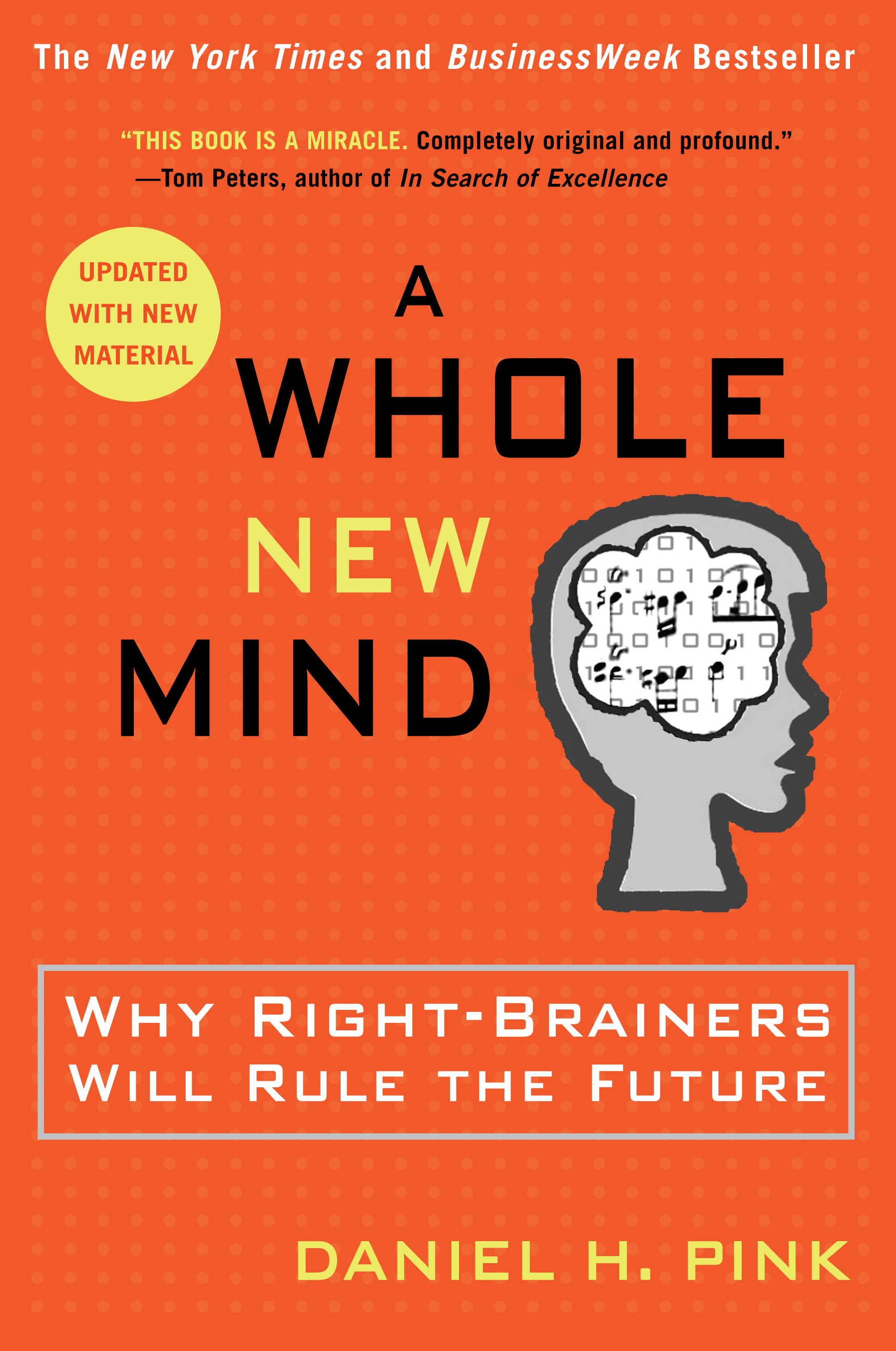
I’ll take a break from Classroom 10 to share this TED Talk with Daniel Pink on motivation, the topic of his next book. Pink wrote A Whole New Mind the book that suggests that the future will require much more right brain thinking for success. This was one of the books that influenced our thinking when we revisited our Outcomes and Indicators and influenced our Classroom 10 initiative.
As I listened to the talk it made me think not only about how we support learning and motivate young people, but also about the interest in merit pay for teachers. Pink shares the results of research over time that show that bonuses for tasks that involve “mechanical skills” work as expected. When the task, however, called for “even rudimentary cognitive skill”, a larger reward led to poorer performance. Wouldn’t the act of teaching require much more than rudimentary cognitive skill to make the critical decisions necessary to create and sustain a classroom where all students experience success? I wonder if those supporting merit pay would call it a bonus or would they see it as an incentive? Is there a difference?
Should the research Pink shares have any influence on the merit pay debate? We are asking teachers to guarantee that all students learn; a task that requires much preparation and decision making. Is it the key to increased performance or might these financial incentives have similar results to those experienced in the business sector? It is interesting that many of those promoting merit pay come from the business sector where the data suggest that incentives don’t work for complex tasks. It doesn’t seem to have any influence on their zeal to move forward with this initiative. Maybe I’m just missing something or my ladder might be leading me to make erroneous assumptions.
As I listened to the talk it made me think not only about how we support learning and motivate young people, but also about the interest in merit pay for teachers. Pink shares the results of research over time that show that bonuses for tasks that involve “mechanical skills” work as expected. When the task, however, called for “even rudimentary cognitive skill”, a larger reward led to poorer performance. Wouldn’t the act of teaching require much more than rudimentary cognitive skill to make the critical decisions necessary to create and sustain a classroom where all students experience success? I wonder if those supporting merit pay would call it a bonus or would they see it as an incentive? Is there a difference?
Should the research Pink shares have any influence on the merit pay debate? We are asking teachers to guarantee that all students learn; a task that requires much preparation and decision making. Is it the key to increased performance or might these financial incentives have similar results to those experienced in the business sector? It is interesting that many of those promoting merit pay come from the business sector where the data suggest that incentives don’t work for complex tasks. It doesn’t seem to have any influence on their zeal to move forward with this initiative. Maybe I’m just missing something or my ladder might be leading me to make erroneous assumptions.
Sunday, August 23, 2009
Questioning thinking skills . . .

Thank you Nancy for your comment and sharing of the importance of the five characteristics in our Classroom 10 work. Reading her comment to the last post makes it difficult to believe that any of the five characteristics would not be included in every lesson. She speaks to each of them; Habits of Mind, active learning, thinking skills, rigor, and key concepts and content as critical components of a lesson and learning embedded in Classroom 10. She is very convincing and I again feel fortunate to be able to learn from her and include her as a member of our leadership team.
The one characteristic of these five that has resulted in discussion is thinking skills. There are some on the administrative team that question whether there should be a thinking skill identified in each lesson. From her comment you can see that Nancy believes that there would be one. Why do you think there are others that might disagree? When might a lesson not have a thinking skill as a component? Please know that the importance of teaching thinking skills is not being questioned just the inclusion of one in each lesson.
I would encourage you to reflect on this conversation about thinking skills and enter into the discussion. You can share your thoughts in a comment to this post and also with any of the ELT members. It would be good if one of the administrators that are questioning the inclusion would share their thinking so that we can have that information as we continue to reflect on this question. I am looking forward to the continued conversation. I am also wondering if there is a right or wrong answer. Whatever emerges from the conversation will influence our Classroom 10 journey and become part of the Tahoma way as we prepare young people for success in post high school learning and work.
Subscribe to:
Posts (Atom)